 | ||
 | | |
| ||||||||
| | |
| ||||||||
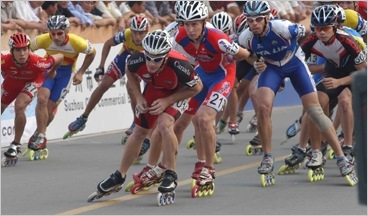
Peter Doucet leads the pack during the marathon at the 2005 World Championships in China. Training SMART By Peter Doucet No matter what your goal — winning a world title or losing a couple of pounds — you've got to have a plan to get you where you want to go. That's why I start each year by sitting down with pen and paper (or keyboard and computer) and writing a training plan. To guide me in this process, I use the SMART goal setting system, outlined below. Give SMART a try and watch your goals roll into view. Here's how: 1) Make your goals as SPECIFIC as possible. Don't set vague goals, such as "I want to improve my technique." You need something more specific. Instead, break down your goals into clearly defined technical challenges, such as improving ankle bend in the setdown, landing on a slight outside edge, and completing your push with all wheels on the ground. Setting specific goals may require some help from a more experienced skater or coach. But it's well worth the trouble. 2) Set MEASURABLE goals. By setting measurable goals you provide yourself with a way to monitor your progress. There are many ways to do this. You can use a stop watch or GPS to chart your speed over various distances. You can use a heart rate monitor to measure your level of fitness. You can simply use a scale to keep track of your weight. Whatever you do, it's a good idea to log your data in a training diary. This will provide you with an easy way to keep track of your progress. (If you're exceeding or falling short of your goals, modify your training regime.)
3) Make your goals both ATTAINABLE and AMBITIOUS. Imagine your goals on a spectrum that ranges from the realistic to the attainable. Make your short-term goals "attainable" and your long-term goals ambitious. 4) Be REALISTIC and positive. Remember that desires and abilities don't always match. Set goals that are realistic and attainable. Realistic goals will keep you motivated over the long run. Unrealistic goals are likely to burn you out and leave you with a bad taste in your mouth. 5) Create a TIME frame for your goals. Set short-term goals for this season; mid-term goals for the end of the season or next; and long-term goals to reach within five years. Make sure the goals feed into each other. List your goals and place target dates next to each one. This will help keep you motivated, focused and on track. Conclusion After you set your goals, start your training. Review your goals regularly and revise accordingly. But it's worth the time and effort. Keep your eye on the prize and that prize will some day be yours!
...
comments powered by Disqus Related reading: • Skate Tip of the Week Archive
...
Copyright © 2007 by INLINE PLANET | ||||||||
| | | | | | | | |