 | ||
 | | |
| ||||||||
| | |
| ||||||||
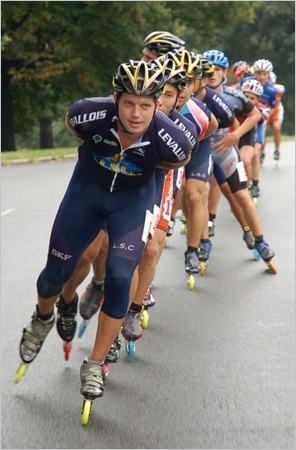
Lead pack at the 2006 New York 100K By Francisco Ramirez I used to think ultra-marathons were for crazies. Why, I wondered, would anyone willingly battle exhaustion, fatigue and pain for three or more hours, which is how long it takes to finish one of these things? But eventually, my skate buddies convinced me I was missing out and I signed up for the two U.S. ultra-marathons: the New York 100K and the Athens to Atlanta Road Skate. By the end of the 87-mile a2a, I understook what they were talking about. Physically, no other skate events can push and test you like an ultra-marathon. And to help you keep going, the ultras have something special: a unique camaraderie that keeps you rolling through the pain. I found that in an ultra, you often hear skaters encouraging each other. "Don't quit now," someone will say when your muscles cramp up. Then, ten minutes later, you will be saying the same thing to somebody else. Now I think of ultra-marathons as the ultimate skating experience. If you are up for the challenge, here are twelve tips that will help you go the distance: 1) Pre-hydrate. Drink lots of fluids in the weeks before the race. This will ensure you arrive at the starting line fully hydrated, which will make it easier to stave off dehydration during the race. Sure, you will be drinking fluids on the racecourse. But even so, keeping properly hydrated won't be easy. 2) Banana-rama. Fortify yourself with potassium, starting three or four weeks before the event. This will help fend off muscle cramps, which often arise during ultra-marathons. You can get your potassium by taking supplements or eating lots of bananas or other foods rich in this mineral, such as potatoes, beet greens, cantaloupes and beans. 3) Carbo load. Contrary to popular belief, carbo loading (eating foods high in carbohydrates, like pasta) is not just a good night-before ritual. It's something you should do for at least a week before the race. What you eat the day before doesn't matter much. Just don't try that weird ethnic dish. That could be a recipe for disaster. 4) Choose your race food. I use Powerbar Gels during races, but not all skaters like them. To figure out what works best for you, test various foods (energy bars, Gu, Pop Tarts, etc.) during long workouts. If they make you feel strong, you've got a winner. 5) Skate long. Skate 70 percent or more of your race distance at least five times before your event. If you are skating the New York 100K, skate at least 70K; if you are skating the full 87-mile distance at a2a, skate at least 69.9 miles. Just don't overdo it. Skating the distance more than twice a week could easily wear you out. 6) Skate for a long time. At least three times before your event, skate continuously for as long as you expect it will take to complete your event. If you expect to finish in four hours, then skate for that long without stopping. You don't have to skate hard. Just continuously. The object is to see how well you hold up. Be sure to bring a filled Camelbak or some water bottles to avoid dehydration. (You can also use these long training skates to experiment with race food.) 7) Dial in the time zone. If most of your practice (like mine) is done at night, force yourself to do some early morning interval training occasionally. This will get your body ready for the early start that is standard for ultra-marathons (and most regular marathons, for that matter.) 8) Crank it up. Incorporate speed workouts into your routine. (Read Gypsy Tidwell's speed workout tips.). Do at least one of these a week. If you train five days a week, do two. 9) Build slowly. Increase your training gradually. Don't jump from two days of easy training one week to five days of hard training the next. It will wipe you out. Instead, increase your load gradually. If you are currently training two days a week, go to one day on, one day off. After a week, see how you feel. If you feel tired, take two days off and start again. Remember: resting is just as — if not more — important than training. (Check back next week to learn how to use a heart-rate monitor to avoid over-training.) 10) Pound the hills. Hills are part of every ultra-marathon. So you'll need to be ready. Find a nice hill and train on it at least once a week. A good hill workout involves climbing the hill and descending at least 10 times in a row. 11) Soak up the rest.
Arrive at the race well rested. This means soaking up as much sleep and relaxation in the weeks before the event as possible. Anxiety may keep you awake on the night before the race. But if you've been getting plenty of rest, you'll be fine. 12) Equipment check. A long race has a way of finding loose parts. So give your skates a thorough going over before your event. Tighten the bolts on your frame. Make sure your axles are secure. And be ready with a set of rain wheels and bearings in case the weather turns wet. Now you're ready to have an experience of a lifetime. Just remember two more things: skate safe and have fun! ...
Aug. 31, 2007 • New York 100K Related reading: • Skate Tip of the Week Archive
...
Copyright © 2007 by the Inline Planet | ||||||||
| | | | | | | | |
 Francisco Ramirez is a speed skater and coach based in Roselle Park, NJ. He started skating in his native Colombia on quads and won a junior national championship on inlines in 1995. A week later, he immigrated to the United States, where he opened his first of several small businesses. He has been a member of the High Gear, Unity and Canariam speed teams. Currently, he manages K2-Empire Speed and coaches Excel Speed, an indoor team based in Hackettown, NJ. Last year, he finished ninth in both the New York 100K and a2a. He is a regular contributor to the Inline Planet.