 | ||
 | | |
| |||||||
| | |
| ||||||
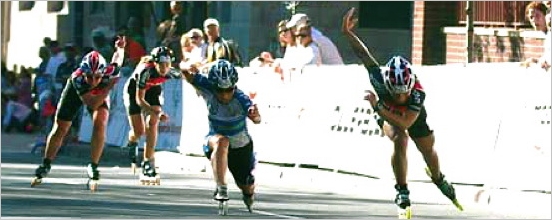
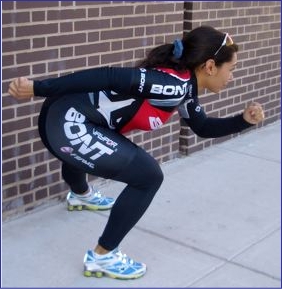
Swinging - Helen Havam (right) battles Jessica Smith at last year's Saint Paul Inline Marathon. By Helen Havam Most skaters don't realize it, but what we do with our arms is just as important as what we do with our feet. Proper arm swing is a key to speed, especially when sprinting or accelerating. As they say, "Swing your arms and your legs will follow." Arm swing can be broken down into two parts: the forward swing and the back swing. Here's how to do each part correctly: Forward swing: With your hand along your side, bend your arm slightly with your thumb pointing up. Swing your arm forward, keeping your elbow close to your body. Backward swing: Starting from the same position, swing your arm down, keeping your elbow close to your body. Keep swinging back until your arm is straight and parallel with the pavement, at which point your thumb should point down. Points to remember:
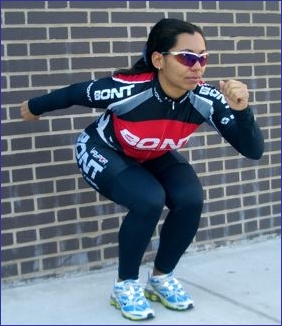
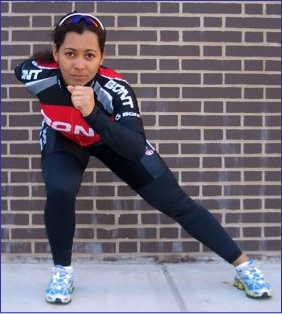
Dry Land Now that you know the basics, practice in front of a mirror with your skates off. (Remember the rule of opposite arm, opposite leg.) Practice:
Once you get the hang of it, put your skates on and head outdoors. Start skating at an easy pace. If you feel confused, back off and find a comfortable skating rhythm before adding arm swing. Once your arms are swinging, check your position. Make sure your
Remember to keep your upper body relaxed. It takes practice, but pays off in the end by eliminating tension. And be sure that each arm finishes its swing at the precise moment the opposite leg finishes its stride. (They should work together as one.) With a little practice, arm swing will become the pump that fuels your acceleration. (March 23, 2007) ...
Related reading: • Skate Tip of the Week Archive. | ||||||
| | | | | | |

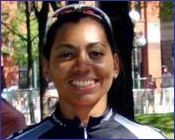 Helen Havam is a veteran inline racer and former member of the Estonian speed skating team. She has competed in the Swiss and World inline cups and has won the National Capital Marathon in Canada four times. She holds the U.S. Junior Olympic record for the 500 (51.29 seconds) and 1000 (1.50.51 seconds) meters. She lives in New York City and helps manage the Redline Speed racing team.