 | ||
 | | |
| ||||||||
| | |
| ||||||||
By Kathy McSparran
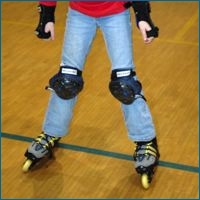
Beginner on inside edges "Get on your outside edges." You've heard it a hundred times, so what does it mean? The first thing you need to understand is the concept of "edges." Skate wheels may look round, but in fact they have three "edges" — the top edge, the inside edge and the outside edge.
"Get on your outside edges" doesn't mean that you should always be on your outside edges. That would be impossible. It means you should land each skate, after your push, on your outside edges. Doing this provides lots of benefits. It lengthens your push, thus giving you more power. It improves your stability and maneuverability. And it eliminates a lot of ankle blistering and bruising. So how do you get on your outside edges?
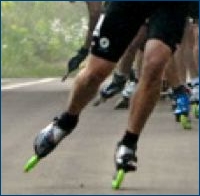
Racer on outside edge Start by focusing your attention on where you set down your skate in relation to your body. When you learn to skate, you naturally assume a wide stance, like a linebacker's. This makes you feel more stable. But as you become more comfortable on skates, your naturally narrow your stance. Once you are landing your feet directly under your hips, you are skating on your center, or top, edges. That's good. But you can do better. The next step is to concentrate on landing each foot closer and closer to the centerline of the body. One way to visualize this is to imagine yourself skating on a straight chalk line and concentrating on landing your wheels directly on top of the line. You can practice this using a lane marker on a street. Just don't get run over!
Once you're landing on the centerline (imaginary or not), you've found your outside edges. Once you've found them, take it a little further. Work on bringing your wheels down on the far side of the centerline. That will give you an even more effective stroke. Don't get discouraged if it's hard for you. It takes time to find your outside edges. Just be patient and remember to have fun. ... Pretty soon, it will be you urging newbies to "get on your outside edges." ...
Related reading: • Skate Tip of the Week Archive comments powered by Disqus
| ||||||||
| | | | | | | | |